Trust Your Gut. Check the Expiry Date First.
"Trust your gut" is the best advice you can give a senior and the worst you can give a junior. A gut is compressed experience with a domain and an expiry date, and the confidence never tells you which one you're holding.

The time your gut saved you and the time it sank you feel identical while they're happening.
That is why "trust your gut" is the best advice in engineering and the worst. Same three words. The only thing that decides which is who's standing in front of you.
It's the phrase I reach for most. I hand it to senior people freely. I would never hand it to a junior, because in their hands it means something else: permission to be confident and wrong.
Your gut is not magic. Herbert Simon founded the study of expertise, collected a Nobel, and in 1992 compressed the mechanism into one line: "Intuition is nothing more and nothing less than recognition."
That's the trick: compressed experience, thousands of hours of patterns filed somewhere you can't consciously reach. A cue pulls a stored pattern and hands you a verdict before you've finished reading the ticket.
For someone who actually paid for those hours, that verdict is the most valuable instrument they own. For someone who hasn't, the machinery still runs. The query still returns. There's just no pattern library behind it.
The answer arrives either way.
Stop asking, "Should I trust my gut?" Ask whether this gut is trained on this problem.
A gut has a domain
Two research camps spent decades fighting about intuition. Kahneman's heuristics-and-biases camp built the catalog of confident experts being wrong. Klein's naturalistic-decision-making camp studied fire commanders making correct calls in seconds.
In 2009 they wrote a joint paper: "Conditions for Intuitive Expertise: A Failure to Disagree."
The failure to disagree produced exactly two conditions. A gut is trustworthy when:
- The environment has stable regularities. The patterns are real and they repeat.
- You had prolonged practice with feedback. Reps where you found out you were wrong.
Miss either condition and the feeling doesn't change. Only the hit rate does. In their words: "subjective experience is not a reliable indicator of judgment accuracy."
Run my own inventory through that filter.
I haven't shipped production code since around 2015, the tail end of a long run in Scala. My distributed-systems gut is still sharp: which queue backs up first, which "temporary" fix is quietly load-bearing, which 2am page is already on its way.
Fifteen years of buying it, and the feedback arrived as pages and postmortems, which is the honest kind. The ground is stable too: queueing physics hasn't moved. Both conditions hold. That gut earns its keep.
My gut about whether some framework that shipped last year is the right pick? No reps. Moving ground. Both conditions fail.
From the inside it feels like the exact same gut. It is not. One is a trained instrument. The other is a director with an opinion.
A gut has an expiry date
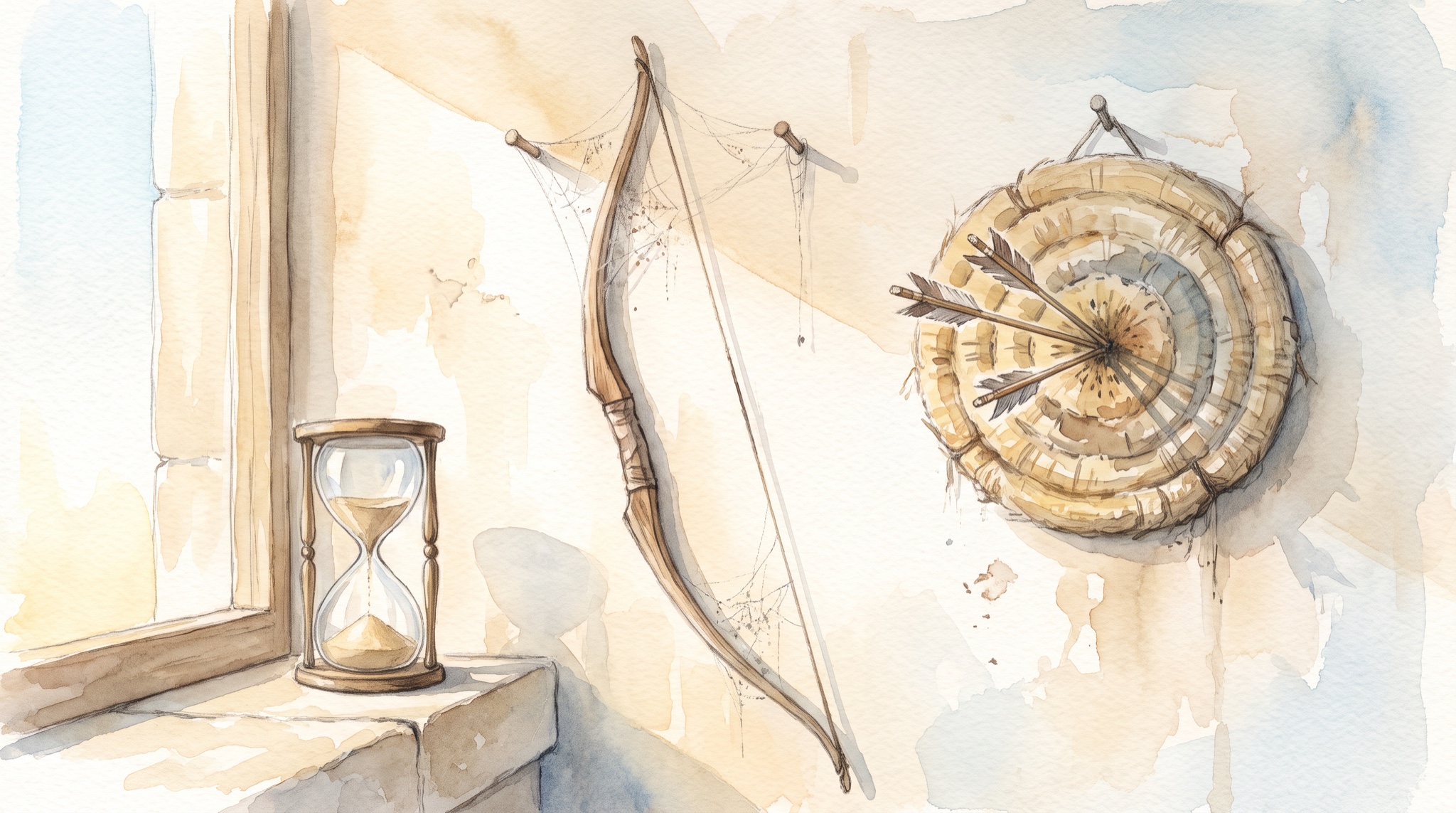
The domain check is not a one-time thing. Skill rots on a schedule.
A 1998 meta-analysis (Arthur, Bennett, Stanush and McNelly: 53 studies, 189 data points) measured what nonuse does to a trained skill. Right after training, loss is roughly zero. After more than a year of nonuse: d = -1.4.
More than a full standard deviation of skill, gone.
Worse for us, cognitive, accuracy-based tasks decay faster than physical ones. Engineering judgment is exactly the cognitive, accuracy-based kind.
So "I haven't been close to this layer in two years, push back on me" is not humility. It's arithmetic.
I call the failure mode the expired gut: intuition that was earned, in a domain that was real, still firing years after the reps stopped or the ground moved.
It runs on two clocks.
How long since your last rep with real feedback?
How fast does the domain itself drift?
Queueing theory drifts slowly, so that gut keeps for years. Framework fashion drifts yearly, so that gut is milk. Nothing about the title on your badge stops either clock.
Knowing where your own expiry lines fall, and refusing to let the title smudge them, is most of the job.
The wrong pattern arrives with the same confidence
Intuition is right when the situation rhymes with ones you've lived: same shape, same mechanics, your pattern-matcher firing on real patterns.
It betrays you when the surface looks familiar but the ground underneath has shifted, and you match on the surface anyway.
The new system that resembles the old one. The candidate who reminds you of someone great. The design that was rock solid at a tenth of the load.
Each is a real cue pulling a real pattern. Just the wrong pattern, matched at the wrong depth, arriving with the same confidence as the right one.
"Can you say why?" almost works
The test I used to offer was simple: real intuition unpacks in hindsight. You felt it in a second, but afterward you can reconstruct the reasoning and it holds. If you can't explain it even after the fact, it was never intuition.
The research corrects me.
Klein's flagship case in Sources of Power (1998) is a fire commander whose evacuation call saved his crew. Asked how he knew, he credited ESP. He genuinely could not explain his own correct call.
Only a structured debrief surfaced the real cue: the fire was too quiet, because it was burning in the basement.
Real experts usually can't narrate their own intuition unaided. The recognition is conscious. The process is not.
So the honest version of my test is this: real intuition rests on real cues, and a careful unpacking afterward can usually find them.
Not you alone, in the moment, under adrenaline. A debrief, or a second person asking basic questions.
If the unpacking finds no cues underneath the verdict, it wasn't intuition. It was a preference, or the answer you already wanted, arriving fast enough to pass for instinct.
The felt confidence proves nothing either way. That's the one sentence both camps signed.
Spend it where it's calibrated
None of this is a case for slowing every call down to a spreadsheet.
A senior who needs data for everything is as broken as a junior who needs it for nothing. Usually that's someone who built a good instrument and then got scared off it by one bad call. Seniority includes knowing what your instrument is for.
The working rule is three moves:
- Spend the gut where both conditions hold. Stable ground, paid-for reps, clock still running.
- Reach for data where they don't. New ground, no feedback loop, expired clock.
- Say which is which out loud. "My gut says ship it, but I haven't been close to this layer in two years, so push back on me."
That expiry-math sentence is the most senior sentence you can say in a room. It trusts the gut and audits it in the same breath.
Say it out loud and the room learns to run the same audit on itself.
Trust the gut where it is calibrated. Reach for data where it is not. Make sure the voice you're trusting is actually yours, actually on this, and not the loudest one in your head doing an impression of experience.
I still reach for "trust your gut." I just check the domain and the expiry date before I hand it over.