SMART Goals: The Two Letters Everyone Cheats On (and Why Cheating Is Rational)
Everyone recites SMART. Then they cheat on Measurable and Achievable. The cheating is rational, the acronym can't fix it, and the fix is safety, not writing craft.

A goal you might miss becomes money you might lose.
That is the story inside SMART. Everyone can recite it on demand: Specific, Measurable, Achievable, Relevant, Time-bound. Then the same people write goals that flunk the exact test they just recited. And feel great about it.
The most successful piece of management trivia ever shipped, and one of the least applied. That gap is the only interesting thing about it.
People actively cheat on two letters: Measurable and Achievable. The cheating is rational. That second part is what the productivity blogs skip.
Even the acronym cheats
The recital above is the modern variant, not the original.
George T. Doran coined S.M.A.R.T. in Management Review, November 1981. His letters were different: Specific, Measurable, Assignable, Realistic, Time-related.
"Achievable" and "Relevant" are later swaps with no single author. And in that same short article, Doran wrote that not every objective needs all five criteria. He warned against forcing a number onto every goal at every level. The inventor never treated it as a checklist.
The checklist worship got bolted on decades after the inventor warned against it, and the reciting never stopped.
Measurable: an affirmation with a deadline
Measurable is where the weaseling lives. A soft measure lets you declare victory no matter what happened.
Watch the difference.
"Reduce the number of known issues in the next release."
"Ship the next release with zero known issues."
The first is a trap you set for your own future self. Kill one bug. Technically reduce the count. Call it a win. Learn nothing.
The second version can actually fail. That is the entire point. A goal that can't fail isn't measuring anything. It's an affirmation with a deadline.
Achievable: god mode
Achievable gets gamed in the opposite direction. People set the bar where they're certain to clear it. Then they look genuinely puzzled that nobody's motivated.
It's god mode in a video game. The second you can't lose, you stop caring.
This isn't my opinion, and it isn't new. Locke and Latham summarized 35 years of goal-setting research in 2002: more than 100 tasks, over 40,000 participants, at least eight countries, lab and field.
Specific, hard goals beat "do your best" every time, with effect sizes from .42 to .80. Performance rises linearly with goal difficulty, right up until people stop believing the goal or run out of ability. A sandbagged bar leaves measurable performance on the table.
The only bar that does any work is the one you're honestly not sure you'll clear. People steer around exactly that bar, on purpose. It's the single bar that can embarrass them later.
The other three letters rarely lie to you. A goal that isn't Specific outs itself the first time someone asks what "done" looks like and the room goes quiet. Relevant and Time-bound are mostly common sense.
The whole game is those two: a target you might miss, at a bar where missing is a live possibility.
Why the cheating is rational
Goals get attached to performance reviews, to bonuses, to the promotion case, to the slide your manager shows their manager.
The moment a goal touches any of that, a goal you might miss becomes money you might lose.
So everyone negotiates toward the softest goal that still sounds ambitious. Your team read the incentives you built, and read them correctly. Don't file that under character flaws.
Wire the number to money and the gaming flips direction instead of disappearing.
In the early 1990s, Sears gave its auto-repair staff a sales quota of $147 an hour. Staff hit it by overcharging customers and performing repairs nobody needed, companywide. The chairman, Edward Brennan, admitted in public that the goal-setting process "created an environment where mistakes did occur."
The case comes from "Goals Gone Wild" (Ordóñez, Schweitzer, Galinsky, and Bazerman, 2009), and their verdict is the sharpest line in the goal literature: goal setting is prescription-strength medication, not an over-the-counter fix.
Attach stakes to a number and people optimize the number. Sandbag it or overshoot it, the gaming is the constant.
The manager is not an innocent bystander. The manager accepts the soft goal, because a team full of green goals is a manager who walks into the review and reports green too. Everyone up the chain has the same incentive. (How goals cascade up that chain is its own disease; I wrote about it in the stairway nobody builds.)
I have sat in the end-of-quarter ritual where targets get gently adjusted to match what already happened, and then we congratulate ourselves on a number we moved last week. Everyone in the room knows it. Nobody says it.
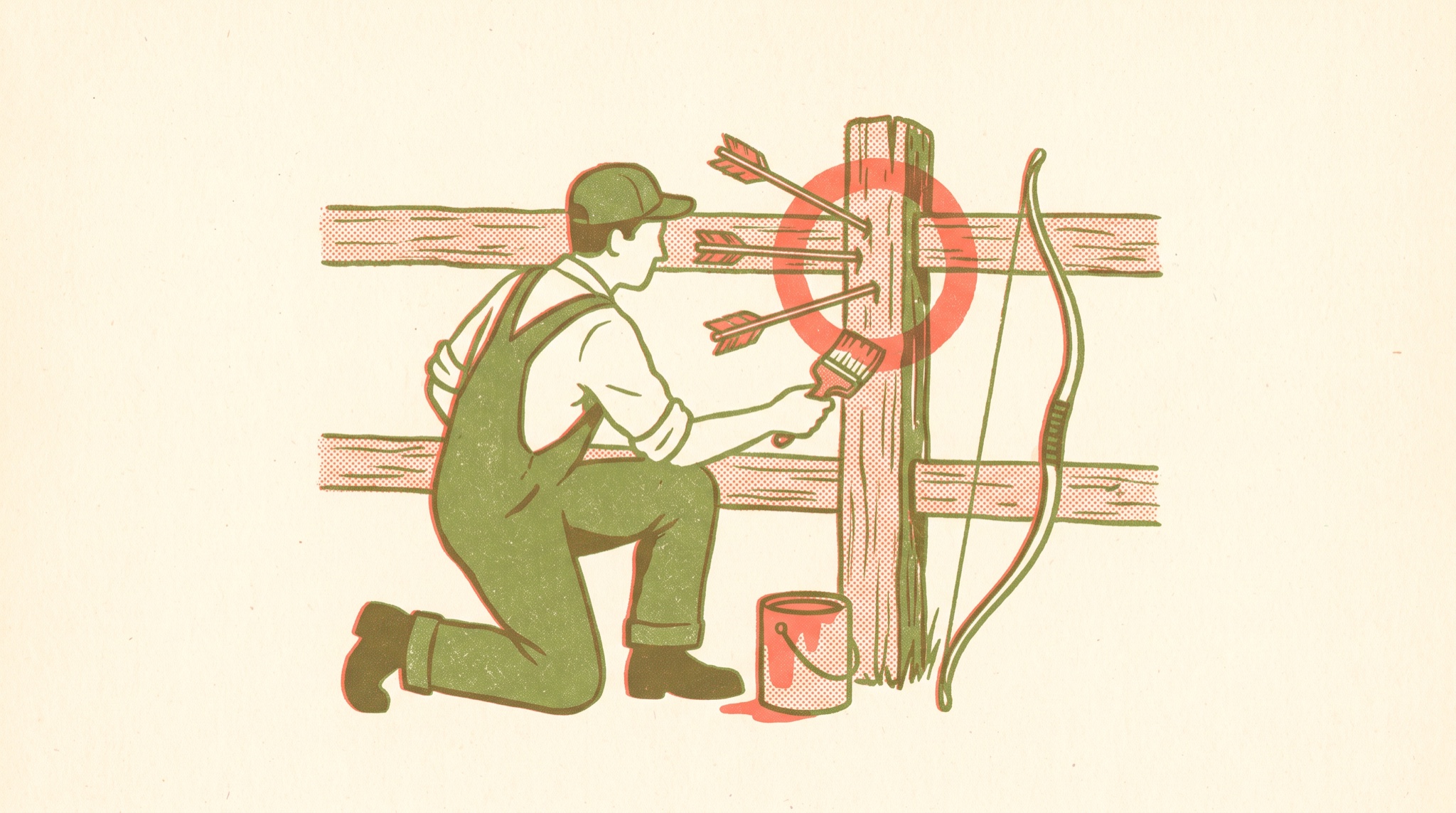
The all-green tell
If your team hits basically all of its goals, every quarter, that is not a high-performing team. Those are forecasts dressed up as goals.
Call it the all-green tell. A wall of green proves one skill: your team learned where the bar stops being safe.
Real ambition produces red every quarter.
It was never a writing problem
The acronym can't fix this. A goal you can fail only gets written where failing it isn't fatal.
Punish every miss, treat every yellow as a black mark in the file, and you are training your whole team to write un-failable goals. From that point your goal-setting process measures exactly one skill: sandbagging.

The fix lives entirely on the manager's side, and it starts before a single goal is written.
Say it out loud: a real goal honestly chased and missed is worth more than a fake one safely hit.
Then prove it the first time someone misses one.
They are watching that moment far more closely than they listened to the speech.