Refuse the Task, Keep the Problem
A clean no that leaves someone stranded is abandonment with manners. The skill that takes years: refuse the task, keep the problem, then prove the yes with something that costs you.

A clean no that leaves someone stranded is abandonment with manners.
There's a satisfying "no" that leaves the other person exactly as stuck as they were. Managers who've just discovered boundaries love it a little too much. You protected your calendar and filed it under discipline.
A clean no is not a skill.
Saying no to the task and yes to the person is harder, because it doesn't end when you decline. The task you refuse in a sentence. The problem underneath it is still sitting there afterward. If you care about the person who carried it to you, that problem is now partly yours to help solve.
Just not by doing the thing they asked.
This is about the person standing in front of you. Declining work on behalf of a team, defending a plate against incoming asks, is a different skill with different moves; more on that one in "Got a minute?" is the most expensive sentence in any company. Here the question is narrower and harder: what your no does to one human, and what you owe them after it.
Separate the person from the ask
Reject the request while staying completely on the side of the person.
Fisher and Ury made "separate the people from the problem" the first of four principles in "Getting to Yes". It sounds obvious. Almost nobody manages it under pressure. The moment you collapse the two, every "no" becomes a referendum on the relationship.
Their second principle hides in the same conversation: interests, not positions. The literal ask is a position. It's the person's first guess at a solution, not the need underneath.
So the useful response to "can you do X" is usually "what are you actually trying to get done". None of this is soft. Skip the question and the frustration doesn't go away, it just moves to someone else's desk.
The yes has to cost you
The fake yes is worse than a clean no.
People decline the task. They're warm about it. They say "let me know if there's anything else I can do." Then they do nothing. The person walks away having heard "yes to you" and received nothing. They learn, correctly, that your warmth is decoration.
"Yes to the person" means you do something, and the something has to cost you or it doesn't count.
Three moves that count, in ascending price:
-
Recut their priorities with them. Sit down and reorder the pile so the problem is survivable without you.
-
Route them to the real owner. Not "try team X". Walk them to the team that genuinely owns the fix and has the capacity, and make the intro yourself. This is not the redirect that pushes incoming work off your own plate. That one protects you. This one serves them.
-
Go clear the runway. Get one of their other fires deprioritized so this one is even reachable. That spends your political capital on their problem.
If your yes-to-the-person was free, it wasn't a yes. People can feel the difference between someone who redirected them somewhere useful and someone who just had a nicer voice while closing the door.

Your report hears a verdict
Declining upward, to your boss or a peer, is one skill. Declining a report who came to you for help is a different and harder one, because the power gap does something ugly to a simple no.
They read it as a verdict, not a scheduling decision.
And the silence was there before you said a word. In a 2003 interview study of employee silence, Milliken, Morrison and Hewlin found 34 of 40 employees had at least once sat on an issue they believed was important rather than raise it with their boss. Barely half said they generally felt comfortable speaking up. The most common reason for staying quiet: fear of being labeled a troublemaker.
Forty interviews, not a census. But the direction is the point. Your clean refusal confirms a fear they walked in with.
A report who brings you a problem and gets a clean refusal learns fast not to bring you problems. That is the single most expensive thing that can happen to a manager.
You don't find out you've gone blind until something you should have seen coming lands on you in a meeting, in front of people, with no warning. The person who would have warned you decided months ago that you weren't a safe place to bring a problem.
Amy Edmondson's 1996 hospital study is the sharpest version of this I know. She expected the better-led nursing units to make fewer medication errors. The data came back inverted: the better units reported more errors, not fewer.
People failed at roughly the same rate everywhere. On the good units they admitted it.
The same trap is waiting for you. Make problem-bringing expensive and you don't get fewer problems. You get fewer reports. After that, the only thing your visible error rate measures is trust.
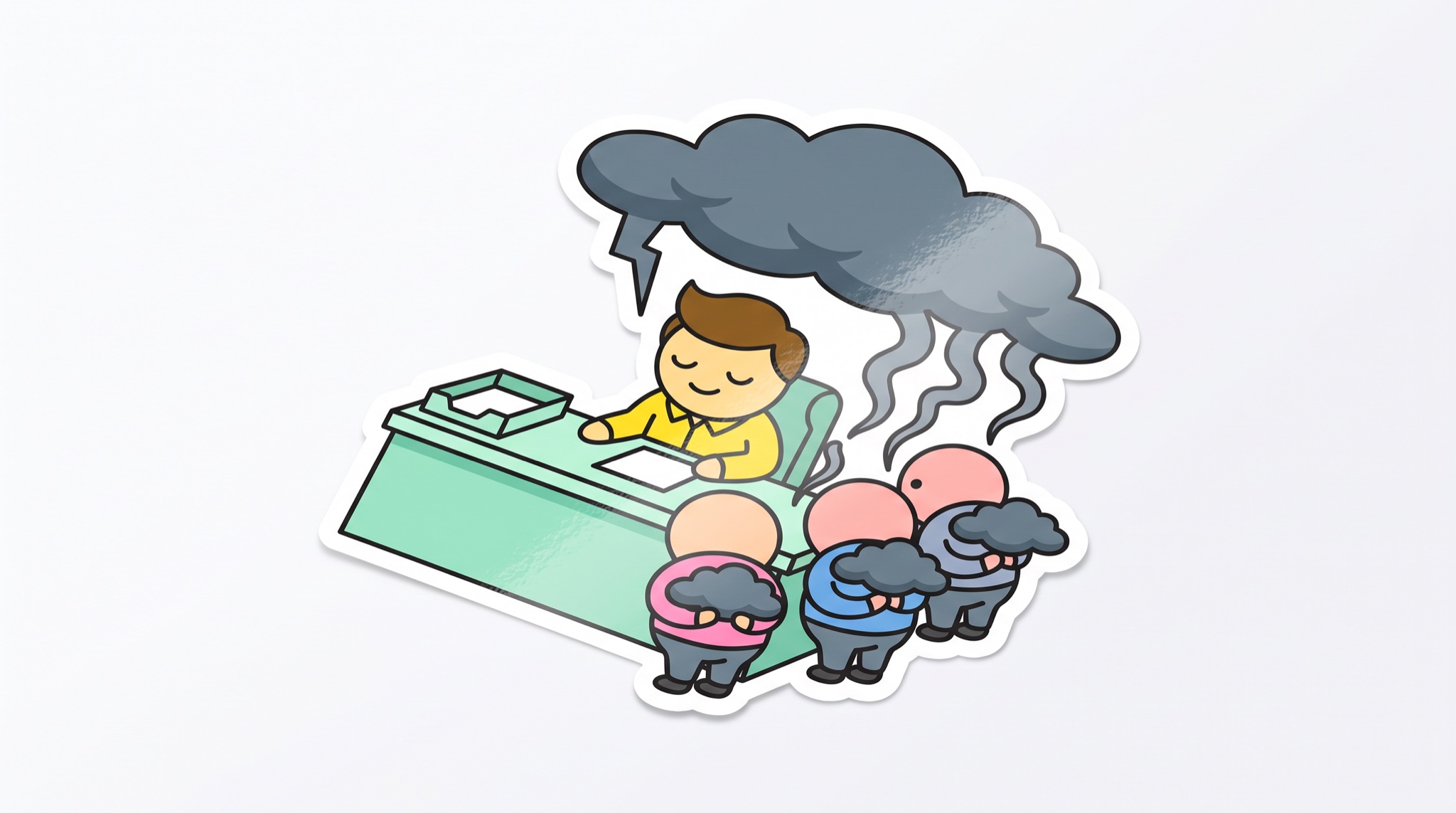
With a report, the yes-to-the-person is the whole interaction. The "no" is to their proposed solution. The "yes" is "this is still our problem and I am in it with you."
Trust decides whether the no lands
Trust is what makes the technique something other than manipulation.
The exact same "no to the task, yes to the person" script, run by someone people don't trust, reads as precisely what a manipulator would say. Nothing in the words changes. The only variable is whether the person saying them has ever backed them up before.
That backing gets banked in small, boring places, mostly the meeting you never cancel, long before the day you need to spend it.
"Learn to say no" is some of the most useless advice in management, and it's everywhere. Toddlers are world-class at saying no. The skill that takes years fits in six words: refuse the task, keep the problem.
The no is free. The proof has a price. Pay it.
I once spent the better part of a year between two teams that each quietly assumed the other was hiding the ball. Nobody had ever built the thing where a "no" could land as "not this, but I've got you" instead of "you're on your own." People stopped routing problems through each other and started routing around each other. The org slowly filled with parallel, redundant work that existed purely because nobody trusted a no.
We both were, a little.