Same number, two cultures, opposite meaning
HR's pulse survey scored me as a bad manager. Three minutes with the team proved the questions were aiming at someone else. The real finding: headquarters and I had spent two years grading the same team with each other's rulers.
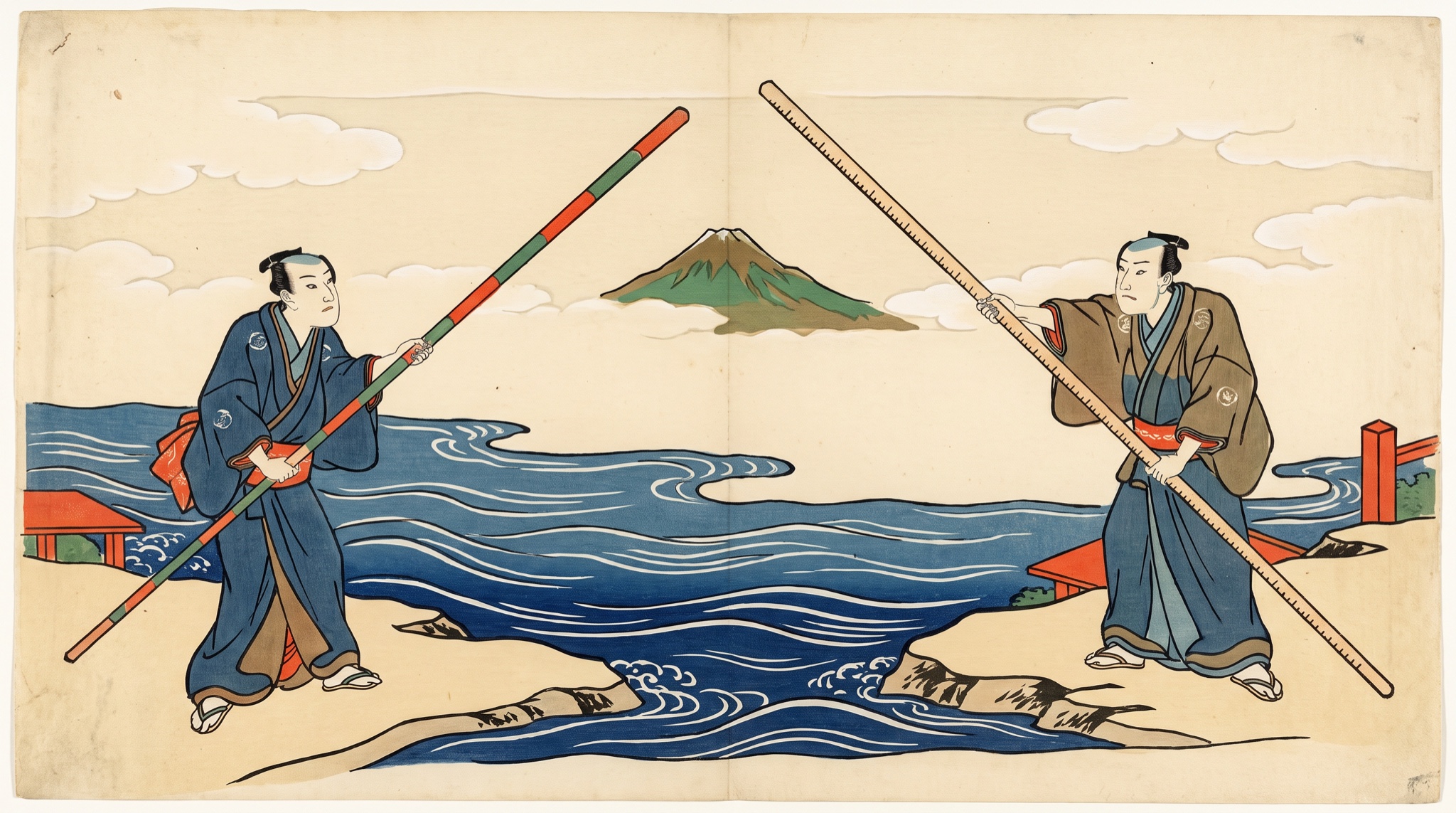
HR's pulse survey scored me as a bad manager.
Three minutes with the team proved the questions were aiming at someone else. The survey was a false alarm. The lesson wasn't.
HR ran one of their pulse surveys. The kind meant to measure whether the org has a pulse, and mostly measures whether mine spikes when the results land. This one came back with a section scoring me as a manager, and the numbers were bad. Not soft. Bad. My heart rate did the exact thing the survey was named after.
It took me a day to stop sulking. Then I pulled the team together and asked the only question that mattered: why did none of this surface before a form dragged it out of you?
Three minutes in, my pulse came back to earth. The answer was hiding in the question design.
We run a matrix. Half my people deliver under a peer of mine. The survey's "your manager" questions never said which manager. Every question that unmistakably meant me scored fine. The cratered ones were the vague ones, answered by people picturing someone else.
The form assumed one manager per person. Where it was written, that's true. In a matrix it's false for half the team. The survey wasn't measuring my management. It was exporting a headquarters default, one question at a time.
False alarm, then. But it pointed straight at the thing I had spent two years failing to explain to anyone above me.
Same number. Two cultures. Opposite meaning.
A strong developer wanted to move into my group. Light on big-data experience, heavy on drive. The executives approved the move over a six-month ramp: keep the old job, close the gap on the side.
One month later he was gone. Hired elsewhere, straight into the role he wanted.
The plan wasn't stupid where it was written. At headquarters an engineer's notice period is three months. Not a company quirk: the Syntec collective agreement, the standard for cadres across French tech. Against that ruler, six months of overlap is two notice periods. Generous. Room to breathe.
Where I sit, Israel's Advance Notice Law makes it one month once you've passed a year. Against that ruler, six months is six notice periods laid end to end. It reads as "we are not serious about you".
Same number. Two cultures. Opposite meaning.
Nobody in the approval chain noticed we were speaking different languages, me included. The plan cleared every desk it crossed because every desk read it with its own ruler.
Both sides of the border
I once built an offshore team from nothing. Months of flying back and forth. Five engineers and a lead, ramped onto our stack.
Then a French company bought us, and over the next year the gravity reversed. I wound that same team down. By then we were the offshore team, and they had become the offshore of the offshore.
So I have stood on both sides of that border. The side issuing instructions, and the side receiving them with no vote.
The view isn't symmetrical. From the center, offshore reads as capacity. From offshore, the center reads as weather: decisions arrive, no forecast, no appeal.
Most people only ever stand on one side and conclude the other side is being difficult. They almost never are. They're running a different default. What everyone calls friction is two defaults grinding against each other while each side insists its own is just "normal".

The friction is predictable, not personal
One of my people joined a project run out of another site, and I did what I always do: asked the product manager to walk me through it.
The project's tech lead tensed. To him, a manager outside his chain taking a close interest was an audit. The opening move of someone coming to take something. To me it was curiosity and a free lesson.
Neither of us was wrong about our own world. We were running opposite assumptions about what a senior person poking around your work means.
I eventually noticed the tension and named it, out loud. Naming it dissolved it. Left alone, it would have calcified into "that guy doesn't trust me", and no survey question would ever have surfaced why.
It runs all the way down to cadence. My people get twitchy if a week passes without a 1:1. An engineer at the other site expects his group manager once a quarter and calls that plenty.
Weekly and quarterly are both just defaults. Export yours as if it were physics and you'll spend years baffled at why people keep reacting "wrong".
Trompenaars and Hampden-Turner spent a decade collecting questionnaires from tens of thousands of managers across some forty countries, and boiled the mess down to seven dimensions of culture.
Don't memorize them. Take the idea underneath: these differences are predictable, not random noise. They cluster and repeat, which means you can look them up in advance, like weather.
Recognition sits right on the model's individualism-versus-communitarianism line. I praise good work loudly and in public, because where I come from that's fuel. Do that to someone whose culture reads public singling-out as exposure, and you've punished them for doing well.
Same gesture, opposite payload.
Unanimously wrong
A multi-culture team, managed by someone who's done the work, beats a monoculture one. Not for the reasons on the diversity slide.
It wins because a monoculture shares one blind spot, perfectly, across every person in the room, and never sees it. Everyone agrees. Everyone is wrong. The failure mode deserves a name: unanimously wrong.

The research backs the conditional, and the condition is the point.
DiStefano and Maznevski, studying global teams in 2000, sorted multicultural teams into three kinds: destroyers, equalizers, creators. Badly run diverse teams underperform homogeneous ones. Diverse teams that map their differences and actually use them far outperform. Homogeneous teams cluster near average: safe, smooth, unanimous.
A decade later Stahl, Maznevski, Voigt and Jonsen ran the meta-analysis: 108 studies, 10,632 teams. Cultural diversity reliably produces both process losses (conflict, weaker cohesion) and process gains (creativity).
The diversity doesn't decide which one you get. The manager does.
The friction on a cross-culture team, once you stop misreading it as people being difficult, is someone attacking the problem from an angle your default would never find. The cost is the translation. The upside is you stop being unanimously wrong.
Three minutes and two years
Headquarters and I spent two years grading the same team with each other's rulers and acting shocked at the scores. The survey just caught it on a form.
What moved it was asking. In private. Before I decided I already knew what someone meant.
Drag the unwritten rules onto a wall and half of them stop being laws. Ask which manager the question meant before you grade the answer.
My pulse settled in three minutes. The cultural gap took the full two years. Guess which one the survey measured.